
Evolution, simply defined, is the gradual development of something from a simple to more complex form. In every industry, evolution, in some form or fashion, has occurred. As humans, we strive to make improvements and ultimately make things work better for us.
In the ice fishing industry, there are numerous great examples of evolution. Take clothing, for example. In the early days, anglers relied on basically whatever they had to keep them warm on the ice. It’s safe to assume that warm is a relative term, as staying comfortable in a soaked pair of workwear is arguably not that great. Anglers knew that something more was necessary – something that allowed them to fish longer, stay warmer, and effectively battle the elements. As a result, the ice suit of the modern era was born. Such suits were far more advanced than their original counterparts and only continue to get better.
The ice auger is no different. What started from a rather rudimentary design has evolved drastically to take a more advanced, and efficient, form.
Hand Powered
Before the development of the auger, anglers relied almost exclusively on chisels and axes as their tools of choice to get through the ice.
While the earliest ice augers have their origins in the later 1800s, with the first US patent being issued to William A. Clark, actual ice augers didn’t really take stride until much later. In the early 20th century, the spoon-style augers, which featured a sharp, spoon-shaped head mounted to a metal shaft, were born. Well before the introduction of the power auger, these hand powered devices continued to evolve – taking a shape more similar to the augers we see today.
These hand powered tools worked, but anglers were limited to drilling the number of holes their manpower allowed. Most fishermen settled for just a few holes, relying on hopes and prayers to send fish rather than tracking them down.
While the purpose of the tool was ultimately the same, functionally, these augers differ drastically from those in the modern area.
Gas Powered
The invention of first power auger is credited to Jake Kluge. As the story goes, Kluge, like so many other fishermen, wanted something more and set out to design that wasn’t simply powered by brute strength. Many assume that first powered augers were gas in nature, but the original designs were built to run while connected to a car battery. The initial gas-powered augers have their roots in the 1960s. In fact, many of the manufacturers that exist today have their foundations in this era.
While these “portable” options seemed like an ideal answer to the original manual and powered augers, anglers knew that things could get better. The evolution of gas augers continued well into the 2000s, with lighter, faster, and better cutting machines being developed year after year.
Gas powered augers offered anglers with this newfound sense of mobility and the ability to drill as many holes as their hearts desired. In the eyes of many, they wondered how things could get much better.
The downfalls of gas were found in areas like reliability and maintenance. They were often known to be fickle and anglers often questioned how many “pulls” it would take to get things started. Not to mention, the absence of proper maintenance meant a high likelihood of no holes being drilled. Additionally, there were always concerns regarding the fuel itself – whether it meant mixing the proper ratio or the dreaded tipped over fuel can.
Propane Powered
Propane powered augers first entered the scene in the 2000s. Instead of relying on a mix of gas and oil, anglers could simply screw in a one-pound propane and get to drilling. For many, they were the perfect alternative to the gas auger.
Anglers touted their abilities in terms of less overall maintenance, no fuel to mix or spill, and ultimately, more reliability. It really felt like the right mix of properties. Anglers could be more efficient and had less concerns.
That being said, propane power was riddled with drawbacks of its own. While they were arguably more reliable and efficient than their gas counterparts, they still weren’t perfect. On average, propane augers were still on the heavy end of the spectrum – often weighing the same or more than their gas counterparts. There was still a level of maintenance required and if neglected, these augers could be more of a nuisance than an advantage. Additionally, the cost of one-pound cylinders seems to rise with every passing season, which can be a costly addition to the budget.
Electric Powered
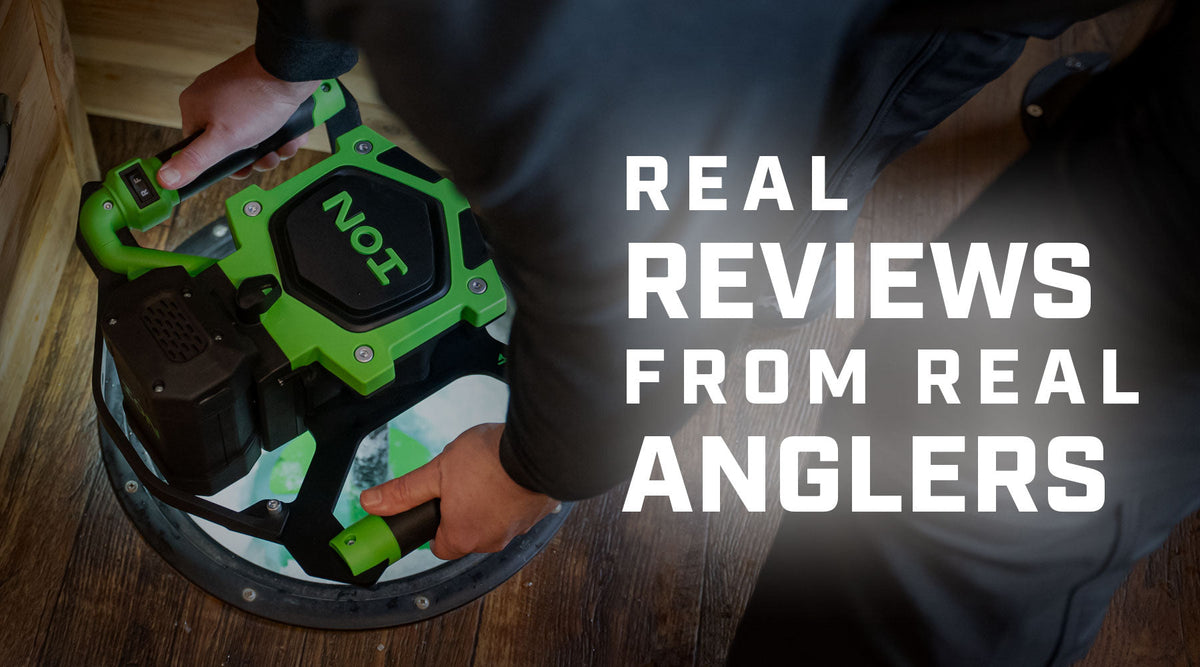
Modern electric augers first hit the market in 2012 with the introduction of the ION®. Since their inception, electric augers have taken the world by storm. While they were initially met with a lot of skepticism, they have proven their worth over and over again.
It wasn’t all that long ago that even the most devout electric users held on to a propane or gas auger – just in case. As the seasons passed, anglers of all types realized how foolish they really were. Modern day electric augers have surpassed all previous ideations in terms of reliability, efficiency, weight and speed.
Take the ION® Alpha, for example. At less than 16 pounds, the auger is nearly half the weight of many gas and electric augers. One handed carrying and the ability to drill countless holes is only a problem for the fish. In terms of speed, it’s safe to say that the Alpha would smoke any of the engine powered opposition. At 3.4 inches of ice per second, it completely decimates the competition.
On the fuel side of things, electric augers have wholly eliminated the need for gas or propane when it comes to drilling holes. High-quality lithium batteries, engineered to withstand the cold, are a fuel source crafted in ice fishing heaven. There’s no pull starts, no warming up, just pop in a battery and start drilling. Efficiency like that is unmatched. With the Alpha’s 2000 inches of ice drilled per charge, anglers should have no concern about being able to drill enough holes. When it comes to maintenance, or lack thereof, a simple inspection and off season charge are all that’s necessary.
Evolutions in the ice industry have come a long way, especially in the auger world. The augers of today are faster, lighter, more efficient and more reliable than they’ve ever been. There’s a lot of key players to thank for these advancements, but the introduction of electric augers arguably deserves the most gratitude. These tools only continue to evolve. When you see the specs on augers like the Alpha, the only question that remains – can we push it even further?